Fall Leaf Sensory Play for Babies, Touch Crunch and Color
Fall leaves are a wonderful, free sensory toy for babies. Here's how to play by age, how to keep it safe around mouthing and choking, and simple ways to keep the fun going at home. No expensive toys needed.

Step outside on an autumn day and the ground is covered in leaves. Here's the lovely part: those leaves are one of the best sensory toys your baby could ask for, and they cost nothing. The bright colors, the crunchy sound, the dry papery feel all give a baby's senses something new to explore.
Good news first: you don't need to pack anything special. A few clean leaves and a grown-up watching close by is really all it takes. The only thing to keep in mind is that babies put everything in their mouths, so a handful of simple safety habits goes a long way.
In this guide we'll walk through leaf play by age, what to watch for safely, and a couple of easy ways to bring the fun home. This fall, let nature do the entertaining.
Table of Contents
- Why leaves make great sensory play
- Leaf play by age
- How to play safely
- Bring the leaves home
- Photo tips
1. Why leaves make great sensory play
One simple material, several senses at once. Your baby sees the reds, yellows, and oranges, hears that satisfying crunch, feels the dry, rough texture, and builds big-muscle and hand control by reaching, grabbing, and holding. Because it all happens outdoors, it feels completely different from the same toys at home, and that freshness is exactly what makes it engaging.
2. Leaf play by age
Match the play to where your baby is right now.
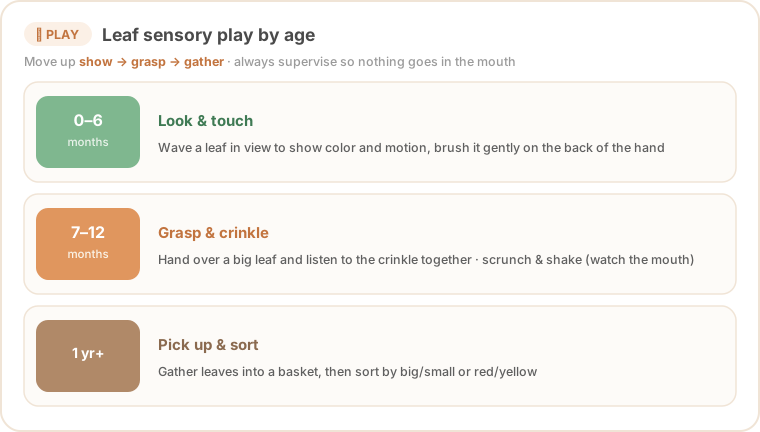

- 0 to 6 months — look and touch: Hold a leaf in front of your baby and give it a gentle shake so they can watch the color and movement, then brush it lightly against the back of their hand so they feel the texture. At this stage you hold the leaf and show it to them.
- 7 to 12 months — grasp and make sound: Hand over a big leaf and listen to the crinkle together. Just crumpling and waving it is plenty of fun. Keep an eye out so it doesn't go in the mouth.
- 1 year and up — pick up and sort: Let them gather leaves into a basket, then try a simple sorting game: big leaves and small ones, reds and yellows.
3. How to play safely
Nature play is worry-free as long as you keep a few things in mind.
- Mouthing and choking: Babies bring leaves straight to their mouth, and small broken bits can be swallowed. Always stay right beside them, and if a leaf heads toward the mouth, take it away gently.
- Only clean, dry leaves: Skip anything moldy, buggy, or dirty, and avoid leaves from roadsides or near drains. Choose the dry, clean ones.
- Leave ginkgo fruit alone: The fruit of the ginkgo tree has a strong smell and can irritate the skin, so stick to plain leaves.
- Wash hands afterward: When you're done, give your baby's hands a good wash, and if they're prone to allergies, watch their skin for any reaction.
These are just ideas, not rules. Every baby is different, so if yours seems especially sensitive or reacts on the skin, don't push it, and check with your pediatrician if anything worries you.
4. Bring the leaves home
Carry home a few clean leaves and the play keeps going indoors. Tuck them between the pages of a book to press and dry them, then glue them onto paper to make a little picture, or tape them to a window and hold them up to the light. Keep watching so the leaves you brought back don't end up in the mouth either.
5. Photo tips
A tiny hand wrapped around a leaf, or the look on your baby's face gazing up at one, is a scene you can only catch in fall. Shoot in soft natural light, keep it short, and go when your baby is in a good mood. If you'd like to plan the whole outing and its safety first, our guide to a fall foliage outing with your baby covers it all.
Frequently Asked Questions
Q. My baby keeps trying to eat the leaves. That's completely normal at this age. Because there's a swallowing risk, stay close and gently take the leaf away whenever it heads for the mouth. If your baby is still very young, it's safest to start with the stage where you hold the leaf and show it to them.
Q. Can I pick up just any leaf? Choose only dry, clean leaves. Skip anything moldy, buggy, or dirty, avoid leaves near roadsides or drains, and leave ginkgo fruit alone.
Q. What age can we start? Very early on, start by showing leaves and letting your baby feel the texture. Once they can grasp, move on to holding and listening to the crunch, and after they're walking, let them pick leaves themselves. Go at your baby's own pace.
Wrapping Up
Leaves light up color, sound, and texture all at once, which makes them a wonderful fall activity. Move up the stages to match your baby, from showing to grasping to gathering, and keep mouthing, choking, and clean leaves in mind so you can relax and enjoy it.
You don't need a single pricey toy. One leaf underfoot can be a whole afternoon of delight for your baby. Start small on your next autumn outing.
Sources American Academy of Pediatrics (AAP), HealthyChildren.org — infant and toddler sensory development and play
American Academy of Pediatrics (AAP) — choking prevention and safe supervision for infants and toddlers
Centers for Disease Control and Prevention (CDC) — developmental milestones for play and motor skills