How to carry a newborn safely in a baby carrier: face in view, chin off the chest
The biggest risk when carrying a newborn in a baby carrier is positional asphyxia from the head folding down. Centered on keeping the face in view and the chin off the chest, here is the TICKS safety checklist to run every time and how to fix dangerous positions.
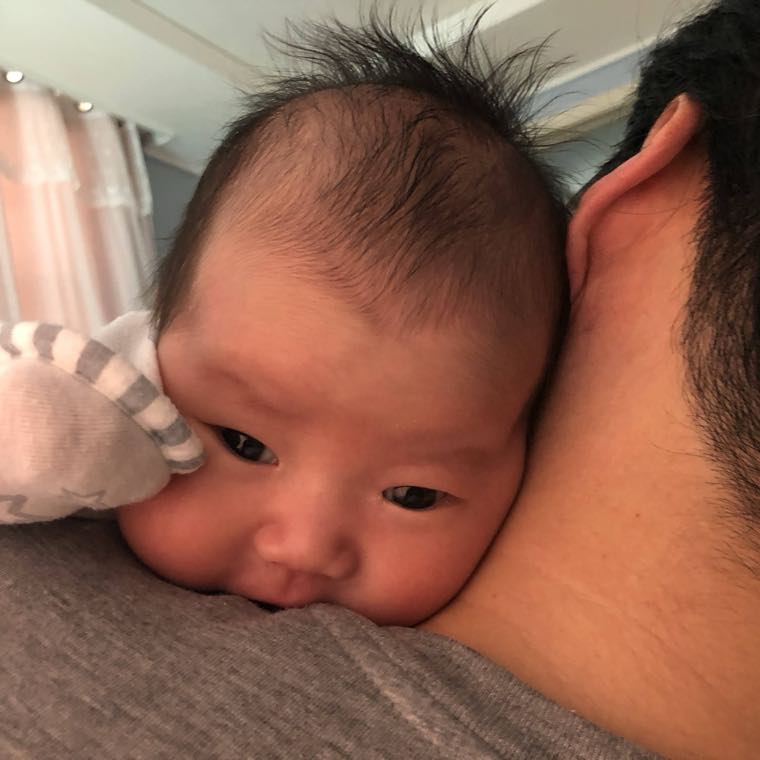
"When I walk with the carrier on, my baby's head droops down as they fall asleep — is that okay like this?" "Can a newborn breathe fine in a carrier, or could they suffocate?" Having both hands free is a relief, but every time you look at that tiny body tucked against you, a knot of worry sits in your chest — and that's something every parent who uses a carrier feels.
Let's start with the bottom line: the biggest risk with a newborn in a carrier is suffocation from the head folding down — what's called positional asphyxia. Because their neck isn't strong yet, the head can tip forward and press on their narrow airway. So it really comes down to two things: keeping your baby's face always in view, and keeping a gap between the chin and the chest. And so you never skip them, it helps to run through the five letters of TICKS every time you put the carrier on.
In this guide we've laid it out one step at a time: why suffocation is a risk for newborns in carriers, the TICKS checklist to run every time, how to fix the most dangerous positions, when and how long you can use a carrier, what to do when your baby falls asleep in it, and the warning signs that mean you should take them out and check right away. Instead of vague worry, let's build a routine you can check the same way every time.
Contents
- Why suffocation is a risk for newborns in carriers
- The checklist to run every time: the five letters of TICKS
- The three most dangerous positions and how to fix them
- From when, and for how long, can a newborn be carried?
- When your baby falls asleep in the carrier
- When to take your baby out and check right away
- Frequently asked questions
- In short
1. Why suffocation is a risk for newborns in carriers
Hearing about carrier accidents can just feel scary, but once you understand how the risk works, it becomes clear what to check for. There are two main risks to watch for with a newborn in a carrier.
A newborn can't hold their head up, and if it folds down
A newborn can't yet support their own head, so it tips forward easily inside a carrier. When that happens, if the chin presses hard against the chest, the already-narrow airway can be blocked and breathing becomes difficult. Suffocation caused by the position like this is called positional asphyxia. What makes it frightening is that it can happen quietly, without a loud cry or any struggle.
Rebreathing when the face is buried
If the face is pressed into the carrier fabric or against the parent's body or clothing, your baby ends up breathing back in the air they just breathed out. The oxygen in that air can gradually drop. That's why there always needs to be open space around the nose and mouth.

So this guide points in one direction. A newborn can slip into danger without crying or making a sound even when they can't breathe well, so it has to be an adult — not the baby — who checks directly every single time. With that in mind, it becomes much clearer why the checklist below matters.
2. The checklist to run every time: the five letters of TICKS
So you can check one thing at a time whenever you put the carrier on, there's a widely used international safety principle. It's called TICKS, after the first letters in English. It isn't complicated knowledge — it's five habits you run through the same way every time.
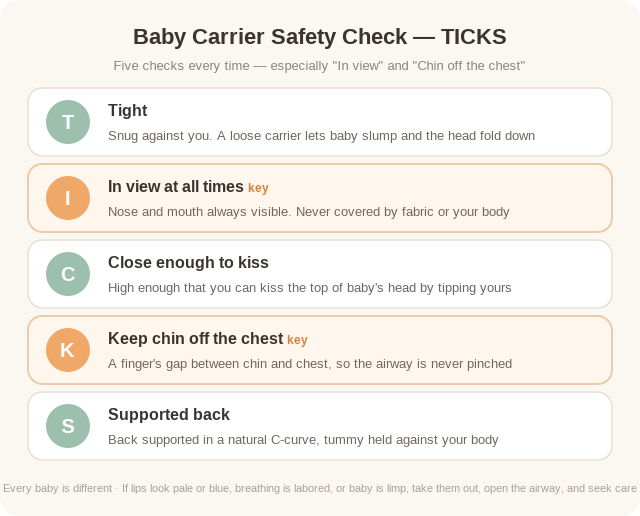
- T — Tight — Fasten the carrier snugly so your baby is held close against you. If it's loose, your baby sinks down and the head and body fold over more easily.
- I — In view — Your baby's face, especially the nose and mouth, should be visible at all times. Never let fabric or your body cover the face.
- C — Close enough to kiss — Carry your baby high enough that you can kiss the top of their head by tipping yours forward. Sinking too low is dangerous.
- K — Keep chin off the chest — Leave a finger's width of gap between your baby's chin and chest, so the head doesn't fold down and the chin doesn't press into the chest.
- S — Supported back — Make sure your baby's back is supported in a natural C-curve, neither forced straight nor overly curled, with the tummy held against your body.
All five matter, but of these, "in view" and "chin off the chest" are the heart of preventing suffocation. Even while you're out, it's worth making a habit of re-checking these two from time to time.
3. The three most dangerous positions and how to fix them
Even when you know the checklist, the position shifts little by little as you walk. These three positions in particular can lead straight to suffocation, so fix them as they happen.
When the face buries forward or to the side
As your baby falls asleep or goes limp, the head often turns to one side and the face buries into the parent's chest. When that happens, gently turn your baby's face to the side so that the nose and mouth are open and clear. Check too that the face isn't pressed into fabric or clothing.
An over-curled position with the chin on the chest
If your baby curls up too tightly inside the carrier and the chin tucks firmly onto the chest, the airway gets compressed. Readjust the carrier's height and snugness to lift the chin off the chest and keep the airway open. A finger's width of gap is the guide.
Carried too low or too loose
If your baby slips below your navel or the carrier is loose, the whole body folds over and it gets dangerous. Rather than slinging them low around your waist, raise them to a kiss-height and fasten firmly. What matters more than the starting position is whether they keep sliding down as you walk.
4. From when, and for how long, can a newborn be carried?
As common as the question of how to carry safely is the question of "from when, and for how long." Rather than fixing on a number, it's better to go by your baby's development and condition.
Timing goes by head control
Pulling together carrier safety guidance, before a baby has full head control it's best to be cautious about carrier use, and when you do use one, a newborn insert with a face-to-face hold is recommended. Up to around 100 days in particular, it's wise to take an especially careful approach. Things get much more stable once the neck and waist are reasonably strong — and if it's hard to tell what stage your baby is at, take a look at when babies gain head and trunk control.
Keep the time short, and check often
Rather than keeping the carrier on for a long stretch at once, it's safer to use it in shorter sessions and check the position and breathing often. If you've had it on for a long time, take your baby out for a moment so they can shift position and rest. The exact time varies by baby and by product, so it helps to go by the product manual together with your pediatrician's guidance.
5. When your baby falls asleep in the carrier
With the gentle sway of the carrier, babies often drift off to sleep. Falling asleep itself is natural, but please do keep in mind that the position shifts more easily at this point.
Once asleep, check the face and chin again
When your baby falls asleep, the neck goes even more slack and the head folds down more easily. So the moment you notice they've fallen asleep, take another look at whether the face is in view and the chin isn't resting on the chest. It's good to check even more often than when they're awake.
If you'll let them sleep a while, move them to a flat surface
A carrier is a tool for short trips, not a place to sleep. If you plan to let your baby sleep for a while, move them onto a flat, firm sleep surface on their back. It's best to avoid soft spots or an inclined surface with the upper body raised; you can find the standards for a safe sleep space in setting up a flat, firm place to sleep. It's fine that your baby fell asleep in the carrier, but don't leave them there for long — check the face or move them to a flat surface.
6. When to take your baby out and check right away
In most cases, just following TICKS well keeps the carrier safe to use. But if you notice any of the signs below, don't hesitate — take your baby out and check right away.
- If the lips or face look pale or bluish, it may be a sign of not getting enough oxygen. Take your baby out at once, lay them down, open the airway, and if they don't recover quickly, call your local emergency number or seek emergency care without delay.
- If the breathing sounds labored, they're grunting as if struggling, or the head has folded with the chin on the chest, release the position right away, lift the head, and open the airway.
- If they're limp or unusually unresponsive, take them out immediately to check, and if the breathing trouble continues, call emergency services or seek urgent care without delay.
The guidance here is for reference, and it varies a lot from baby to baby. Babies born premature or at a low birth weight, or those with a respiratory condition in particular, are safer seeing a pediatrician before using a carrier. If anything seems even a little different from usual, or a worrying sign keeps coming back, don't judge it alone — check with a doctor.
Frequently asked questions
Q. Can I put a newborn in a carrier?
Even before head control, you can use one with a newborn insert and a face-to-face hold, but you'll need to be that much more careful. Carrying with the face in view and the chin off the chest, and checking often, is the baseline. Be especially careful up to around 100 days, and if your baby is small or you're worried, talk it over with your pediatrician.
Q. My baby keeps dropping their head and sleeping in the carrier — is that okay?
When the head drops and the chin presses onto the chest, the airway can be compressed, so you shouldn't leave it like that. Raise the carrier to a kiss-height, and make a finger's width of gap between the chin and chest. If your baby is asleep, check even more often that the face is in view, and if you'll let them sleep a while, it's better to move them to a flat surface.
Q. How long a day can I use a carrier?
Since the set time varies by baby and by product, it's hard to give a firm number. Still, rather than using it for a long stretch at once, it's safer to use it in shorter sessions and check the position and breathing often. If your baby seems uncomfortable or is sweating a lot, take them out to rest.
In short
- The risk to watch most with a newborn in a carrier is positional asphyxia from the head folding down. Since the neck isn't strong yet, an adult needs to check directly every time.
- Run the five TICKS points every time, and of them, keeping the face in view and the chin off the chest is the core. A buried face, an over-curled position with the chin on the chest, and carrying too low and loose should all be fixed as they happen.
- It's fine that your baby fell asleep in the carrier, but the position shifts more easily, so check the face, and if you'll let them sleep a while, move them to a flat, firm surface. If you see blue-tinged lips, labored breathing, or limpness, take your baby out at once, open the airway, and seek emergency care.
Jotting down in Babyfolio for a few days when you went out with the carrier, whether your baby slept, and how they seemed will bring the outing length and rhythm that suit your baby into view. Setting out with your baby held close today, carefully, you're already watching over them well.