When Breastfeeding Wears You Out: Choosing Between Exclusive and Mixed
When you're torn between staying exclusive and adding formula, deciding by criteria rather than emotion makes it far easier. Using three lenses—supply, nipple confusion, and parent burnout—this guide lays out, situation by situation, how to choose between staying exclusive and switching to mixed feeding.

"I'm so worn out by breastfeeding—do I really have to make it all the way to exclusive?" "If I give one bottle of formula, is exclusive breastfeeding over?" On the days when round-the-clock nursing leaves your body and mind completely empty, weighing whether to keep going exclusively or add some formula is a crossroads almost every breastfeeding parent passes through at least once.
Here's the bottom line first: whether it's exclusive or mixed feeding, if your baby is feeding well and growing well, both are good choices. And giving formula once does not mean exclusive breastfeeding is gone forever. Depending on how you use supplementing, there's plenty of room to come back to breast milk. So instead of agonizing over "which is more right," it helps to look at just three things and decide what fits your situation: whether your supply is truly low, whether nipple confusion is a concern, and whether you as a parent have hit burnout.
In this article we'll start with what exclusive and mixed feeding actually mean, walk through the three decision lenses one by one—supply, nipple confusion, and parent burnout—then put them together into situation-by-situation guidance, and finally cover the signs where you shouldn't decide alone and should see a doctor. Whichever you choose, let's build the criteria together so you can decide without guilt.
Contents
- What exclusive and mixed feeding mean
- Lens one: is your supply really low?
- Lens two: nipple confusion when you go mixed
- Lens three: parent burnout is a real criterion too
- So how do you decide? A situation guide
- When not to decide alone—get it checked
- Frequently asked questions
- Wrap-up
1. What exclusive and mixed feeding mean
Before deciding, it helps to sort out the words. Exclusive, mixed, and formula-only sound similar, but they point to slightly different things.
Exclusive, mixed, and formula-only
Exclusive breastfeeding means feeding only breast milk, with no formula. The World Health Organization (WHO) and health authorities generally recommend breast milk only for about the first six months, and continuing alongside solids after that. Mixed feeding uses both breast milk and formula, and formula-only means feeding formula alone.
A recommendation is just a recommendation, not a failure
One thing worth underlining here: "recommended" does not mean "you've failed if you can't." The breastfeeding recommendation is a guide pointing out the benefits of breast milk—it's not a stamp that says you're a bad parent if you can't do it exclusively. Depending on your health, your supply, returning to work, or your circumstances, either path can be a perfectly good choice.

So the direction this article takes isn't "exclusive is proof of a better parent"—it's your baby feeding well and growing well. Feeding and growing well is the goal; the feeding method itself is not. With that in place, you can look at the rest of the criteria far more calmly.
2. Lens one: is your supply really low?
The most common reason people give up on exclusive breastfeeding is "it feels like I don't have enough milk." But that "feeling of not enough" is often quite different from an actual shortage. So the first step is telling the feeling apart from the real signs.
Signs that feel like low supply but usually aren't
The following can feel like evidence of low milk, but are usually not proof of a shortage.
- Breasts feeling smaller or softer than before
- Getting only a little when you pump
- Your baby wanting to feed again soon or fussing right after a feed
- Wanting to feed frequently for a stretch of time
Softer breasts are often a natural change as milk production and demand settle into balance, and pumped output differs from what a baby draws directly, so it isn't a measure of your supply. Fussing or wanting to feed often after a feed is also commonly due to growth spurts or the urge to suck.
What to actually check
Whether your supply is enough is best judged not by feel, but by the signs your baby gives.
- Whether wet diapers come at least six times a day, pale and plentiful
- Whether your baby is passing stools well
- Whether weight is trending steadily upward
- Whether you can hear swallowing ("gulp") sounds during a feed
If these indicators look fine, your supply is usually enough even when it "feels" low. If you'd like to look at these signs in more detail, we've laid them out point by point in the signs that tell you whether your supply is truly low. Milk basically works on a demand-makes-supply system, so the more often and the more effectively your baby latches, the more your supply tends to follow.
If weight and wet diapers look fine, you're on the side where you can keep going exclusively a bit longer. On the other hand, if things are unclear or you notice what to check when weight gain is slow, consider supplementing while also seeing your pediatrician or a lactation consultant.
3. Lens two: nipple confusion when you go mixed
If supply is the lens for "can I keep going exclusively right now," nipple confusion is the lens for "protecting the room to return to exclusive when you go mixed." Even if you choose mixed feeding, paying attention to just this one thing widens your options.
What is nipple confusion?
A bottle lets formula flow fast and plentiful with only a little sucking. The breast, on the other hand, takes stronger, longer sucking. So when a baby gets used to the easier side, they can start refusing the more effortful breast—that's nipple confusion. It's thought to have a bigger effect especially when bottles are used often around three to four weeks of age, before the latch is well established.
How to protect the chance of exclusive while going mixed
The basics of mixed feeding, boiled down, look like this.
- Start supplementing after the latch is reasonably settled
- Offer the breast first, and fill in with formula only as much as is missing
- Supplement only the amount truly needed, tapering gradually while watching your baby
- Use a slow-flow newborn bottle and feed slowly, with pauses
- If possible, use expressed breast milk first

When you use bottles and supplementing carefully like this, the path back to exclusive stays open even while you're mixed feeding. Giving formula once doesn't end exclusive breastfeeding—how you use supplementing is what matters. The amount and frequency of supplementing vary from baby to baby, so rather than matching a fixed number, adjust by watching whether your baby is feeding and growing well.
4. Lens three: parent burnout is a real criterion too
If supply and nipple confusion are lenses that look at the baby's side, the parent's body and mind matter just as much. This isn't something to "just endure"—it's a real variable that belongs on the scale too.
Signs of burnout
If signs like these continue, it may be a warning your body is sending.
- Sleep deprivation stacking up over several days with no recovery
- Pain with every feed, or dreading the time to nurse
- Crying often and feeling listless, or being crushed by guilt over not breastfeeding exclusively
- The pressure to keep exclusive making it hard to go out, return to work, or even rest
This state is never about "weak willpower." Sleep often falls apart because the baby wakes frequently at night; sorting out whether frequent night waking is hunger or light sleep can sometimes reveal a clue to lighten night feeds a little.
The choice when you're burned out
If a parent is running on empty, it's hard to call breast milk the best option. Swapping just one night feed for formula to sleep a few hours straight, or adding one daytime supplement to catch your breath—even that much partial mixing often opens up some breathing room. If circumstances call for it, moving fully to formula is not something to feel guilty about either.
When a parent is at ease, the baby is at ease too. Burnout isn't something to endure—it's a sign to adjust. That said, if tears and listlessness run deep and long, or postpartum depression is a concern, this isn't something to white-knuckle alone; it's an area that needs professional help. We'll come back to it in the next section.
5. So how do you decide? A situation guide
Now let's bring the three lenses together. The below isn't a clean-cut answer but a set of "tendencies" to help you find direction. Use it to gauge which side your situation is closer to.
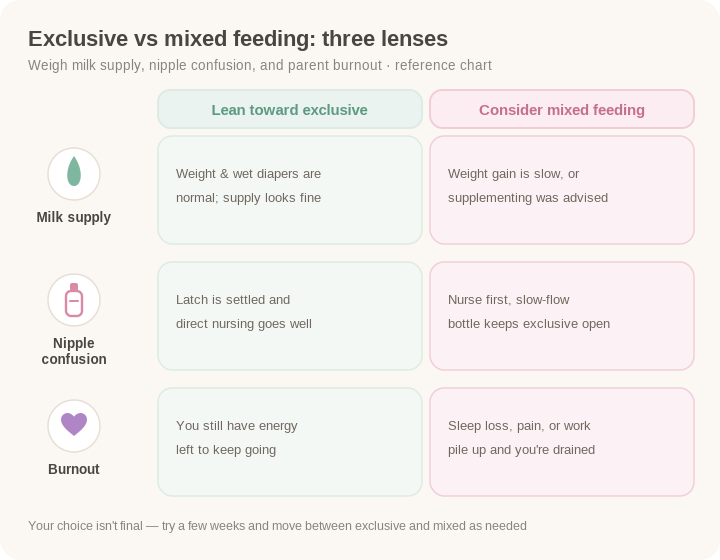
| When you can keep watching with exclusive | When mixed feeding is worth considering | The answer is what you can sustain |
|---|---|---|
| Weight and wet diapers are normal, so supply is actually enough | Weight isn't rising, or supplementing was advised | This decision isn't permanent |
| Latch and pain are manageable | Pain or engorgement/clogging is severe | You can try a few weeks and adjust again |
| You still have reserves to keep going | Burnout, return to work, and sleep collapse overlap | Moving between exclusive and mixed and back is fine |
When you can keep going exclusively
If your baby's weight and wet diapers are normal, the latch and feeding pain are bearable, and you still have reserves left, you can keep going exclusively a little longer—while caring for frequent feeds and a good latch, and filling any gaps with lactation support.
When switching to mixed is worth considering
If weight gain is slow and supplementing was advised, pain or engorgement is severe, or burnout, returning to work, and sleep collapse have piled up, it may be time to consider mixed feeding. Here, use the supply-protecting tips above and start lightly, with partial supplementing.
The answer is the way your family can sustain
The most important thing is that this decision isn't a one-way door you can't reverse. You can try a few weeks, watch how you and your baby are doing, and adjust again; moving from exclusive to mixed and back to exclusive is completely fine. In the end, the answer is the way your family can keep going without burning out.
6. When not to decide alone—get it checked
Most feeding worries can be adjusted slowly while watching your baby. But the signs below are cases where, before weighing feeding methods, you shouldn't decide alone and should see a doctor.
- If your baby isn't gaining weight or is losing it, has fewer than six wet diapers a day, is limp and not feeding well, or jaundice is worsening, see your pediatrician without delay. These can be signs of a different nature from the feeding-method choice.
- If a parent's breast is red and swollen with fever or body aches, mastitis may be the concern. In that case, rather than stopping feeds on your own, continuing to feed while getting medical care is generally recommended. Don't decide alone whether to stop—confirm it with a visit.
- If postpartum depression is a concern, severe listlessness continues, or thoughts of harming yourself or your baby arise, don't put it off—talk to a professional right away. This is not something to endure through willpower.
The counts and thresholds noted here are for reference and vary a lot from baby to baby. Supplement amounts and feeding intervals are better set by watching your baby than by matching a fixed number, and if worrying signs repeat or things look very different from usual, checking with a breastfeeding specialist, your pediatrician, or a local health center is the safest step.
Frequently asked questions
Q. If I give one bottle of formula, is exclusive breastfeeding gone for good?
No. Supplementing once doesn't end exclusive breastfeeding. If you use bottles carefully—offering the breast first and filling in only what's missing, using a slow-flow bottle, and tapering supplements gradually—room to return to exclusive remains. What matters isn't whether you gave formula, but how you use supplementing.
Q. Is exclusive breastfeeding definitely better for the baby than mixed?
There are clear reasons behind the breastfeeding recommendation, but that doesn't mean mixed or formula-only is bad for a baby. If your baby is feeding well and growing well, exclusive, mixed, or formula-only are all good choices. A parent's health and circumstances are an important part of a baby's happiness too.
Q. I'm so exhausted I want to stop exclusive breastfeeding, but I feel guilty.
Wanting to stop because you're exhausted isn't weak willpower—it's a real sign your body and mind are sending. When a parent is at ease, the baby is at ease too. Whether you catch your breath with partial mixing or switch to formula, it's not something to feel guilty about. That said, if listlessness runs deep and long, please do talk it through with a professional.
Wrap-up
- Exclusive, mixed, or formula-only—if your baby is feeding well and growing well, all are good choices. Remembering that the goal is a thriving baby, not the feeding method itself, lightens the load.
- The decision is easier through three lenses: is supply truly low, is nipple confusion a concern, and have you hit burnout. If weight and wet diapers look fine, you can keep going exclusively; if weight gain is slow or burnout overlaps, mixed is worth considering.
- You can readjust this decision anytime. But if there's weight loss, fewer wet diapers, severe jaundice, suspected mastitis, or signs of postpartum depression, don't decide alone—be sure to reach out to a clinic and professionals.
Jotting down which side you nursed on, your feeding intervals, and how much you supplemented for just a few days in Babyfolio makes the rhythm of your supply and the taper of supplementing visible—so it gets much easier to judge whether you can keep going exclusively right now. Whatever you choose, having made it through an exhausting day, you are already doing more than enough.