Signs Your Baby Is Ready for Solids: A 5-Point Checklist to Know If It's Time
Wondering when to start solids? Age alone doesn't decide it. Use this simple yes/no checklist of 5 developmental signs — head control, sitting with support, the tongue-thrust reflex fading, and interest in food — to see if your baby is ready, plus what to do if the signs aren't there yet.

"My baby's getting close to six months — is it time to start solids yet?" And then you go looking for the answer and it only gets muddier: some sources say start earlier, others say wait, and you end up unsure what's actually right. If this is your first baby, almost everyone hits this exact moment of doubt at least once.
Here's the most important part up front: the calendar alone doesn't decide when to start solids. Two babies the same age can be in very different places — one may be ready, another may do better with a little more time. What actually tells you is the set of developmental signs your baby shows you.
This article turns the readiness question into a simple yes/no checklist of 5 signs, drawing on guidance from the American Academy of Pediatrics (AAP) and the World Health Organization (WHO). We'll walk through each sign, and — just as importantly — talk through what to do if the signs aren't there yet. Every baby is different, so let's find the timing that fits yours.
Table of contents
- When do babies usually start solids?
- The "5 signs" readiness checklist
- If the signs aren't there yet, it's okay to wait
- Once the signs are there — how to offer that first taste
- Easy things to get mixed up: drooling, weight, and age
- Frequently asked questions
- Summary
1. When do babies usually start solids?
Let's start with the big picture. The AAP recommends introducing solid foods around 6 months of age, and not before 4 months. The WHO similarly recommends exclusive breastfeeding for about the first 6 months, then starting complementary foods alongside continued breastfeeding or formula.
So "around 6 months" is a general guide, not a hard start date. It doesn't mean "begin the day your baby turns 6 months." It means that right around this window is when most babies grow into the skills they need — and the surest way to know is to watch your baby, not the calendar.

As your baby approaches this age, rather than locking in a start date all at once, give it a little time and watch closely. When several of the signs below start showing up together, that's your cue that a start time suited to your baby is getting near.
2. The "5 signs" readiness checklist
Readiness is best judged by whether these five signs are showing up together. Rushing in on just one is less reliable than seeing a few of them line up. Go down the list and check each one off — yes or no.
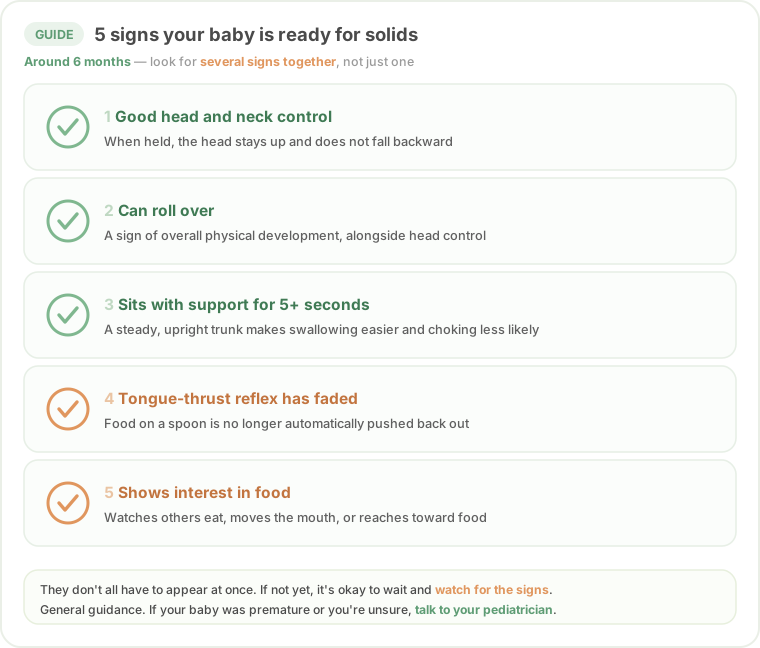
1. Good head and neck control
To swallow food safely, a baby needs to hold their head steady and upright. If their head no longer flops backward when you hold them and they can keep it up on their own, one of the key foundations is in place.
2. Can roll over
Whole-body development is a useful signal that things are coming together. Being able to roll over is one marker that your baby's overall motor development is progressing — look at this alongside head control rather than on its own.
3. Sits with support and holds their head and trunk up
Your baby doesn't need to sit perfectly on their own yet. What you're looking for is this: when propped up or seated in a high chair, can they keep their upper body upright for about 5 seconds or more? A stable, upright trunk makes swallowing smoother and lowers the chance of gagging. It's safer not to feed solids to a baby who is lying down or slumping backward.
4. The tongue-thrust reflex has faded
Newborns have a reflex that pushes anything entering the mouth back out with the tongue — often called the tongue-thrust or extrusion reflex. It's protective: it helps a young baby spit out things that are hard to swallow. But while it's still strong, food gets pushed right back out when you offer a spoon. As babies grow, this reflex fades, and when your baby stops pushing the spoon out with their tongue and starts accepting it, that's a sign the swallowing pieces are falling into place.
5. Shows interest in food
Watching intently while you eat, moving their mouth as if chewing, reaching for food on your plate — these can all be your baby's way of saying "I want to try that too." It's often a sign they're getting ready, in their own time, to take on the new experience of eating.
When these five start appearing together, a start time suited to your baby is getting close. They don't all have to line up at the exact same moment, but head control, sitting with support, and the fading tongue-thrust reflex are especially important foundations. For a closer look at how to read each of the readiness signs, we go deeper in our companion guide on the readiness signs.
3. If the signs aren't there yet, it's okay to wait
"My baby's almost six months and still pushes the spoon out with their tongue." "Other babies have started, but mine isn't showing the signs." If that's you, take a breath — it's okay. Babies develop at their own pace, so the point when the signs line up naturally varies from one baby to the next.
Some parents wonder whether delaying solids might help prevent food allergies. On this, the AAP is clear: there's no good evidence that holding off on solids — or on specific potentially allergenic foods — prevents food allergy. In fact, current guidance leans the other way, suggesting that introducing common allergenic foods around the same time as other first foods may be helpful for many babies. So there's no need to delay out of allergy worry, and no need to rush just because of a number on the calendar. Going by the signs is the most reliable guide.

That said, waiting a long time past the window is a different matter. From around 6 months, breast milk or formula alone starts to fall short on certain nutrients — iron in particular — which is one reason most babies need complementary foods by then. If your baby is well past 6 months with no signs, or you're unsure how to proceed, check in with your pediatrician or at a well-child visit. When you're caught between "it's fine to wait" and "I should ask someone," asking the person who knows your baby is always the reassuring move. Every baby is different, so if something keeps nagging at you, that's reason enough to talk it through.
4. Once the signs are there — how to offer that first taste
When the signs check out, you're ready to begin. There's no need to offer much at first. A gentle way to start looks like this.
Start with a small amount, once a day
Offer a small amount — about a teaspoon — of a smooth, single-grain infant cereal or a simple pureed food, using a small spoon. If it's going well, build up slowly over a week or two. Keep it to once a day at this early stage.
The goal is practice, not volume
Early solids aren't about packing in calories. The main point right now is practicing swallowing and getting used to new textures and tastes. Some days it won't go smoothly, and that's completely expected — follow your baby's pace and take it slow.
For what to offer and in what order as you expand the menu, see our guide on what to offer and in what order. And for watching for allergic reactions to new foods as you introduce them, our guide on spotting signs of a food reaction walks through what to look for.
5. Easy things to get mixed up: drooling, weight, and age
A few things often get confused with the real readiness signs. Here's how to keep them straight.
More drooling = a readiness sign?
Extra drooling is common around this age, but on its own it doesn't settle the question. Treat it as background information at most, and judge by the full set of five signs.
Doubled birth weight = the go signal?
You may notice things like your baby reaching roughly double their birth weight, or seeming hungry again soon after a good feed. These can show up alongside readiness, but they're supporting clues — the five developmental signs come first.
Turned 6 months = start right away?
Age gives you the window — "around 6 months" — not the exact day. It's not "the day arrived, so we begin." It's "are the signs there?" and deciding from that.
Frequently asked questions
Q. If I don't start right at 6 months, is my baby behind? No. "Around 6 months" is a general guide, not a deadline. If the signs aren't there right at 6 months, it's reasonable to keep watching for a little while. If your baby is well past 6 months with no signs, or you're worried, check in with your pediatrician.
Q. Does exclusive breastfeeding change when to start solids? The signs that tell you a baby is ready are basically the same whether they're breastfed or formula-fed. One thing to keep in mind: from around 6 months, iron can run short — especially for breastfed babies — so iron-rich first foods matter. If you're unsure how to proceed, a well-child visit is a good place to ask.
Q. Should I wait until the first teeth come in? Teeth aren't a requirement. Early solids are smooth and pureed, so your baby can manage without teeth. Go by the five developmental signs instead.
Summary
When to start solids isn't set by the number on the calendar — it's set by the developmental signs your baby shows you. The general guide is around 6 months. When good head and neck control, rolling over, sitting with support for 5+ seconds, a fading tongue-thrust reflex, and interest in food start showing up together, a start time that fits your baby is getting close.
And if the signs aren't there yet, there's no need to panic — development comes at its own pace. No need to delay out of worry, no need to rush by the calendar; watch your baby and move at their pace. If you're still unsure past 6 months, your pediatrician or a well-child visit is always there to talk it through.
Sources
American Academy of Pediatrics — HealthyChildren.org, "Starting Solid Foods"
American Academy of Pediatrics, "Healthy Habits Start Early: Tips for Introducing Solid Foods"
World Health Organization — Infant and young child feeding
Pathways.org — When to Start Solids: Signs Your Baby Is Ready