Easing Off Contact Naps From Newborn to Five Months
When your baby sleeps soundly in your arms but wakes the moment you lay them down, you don't have to end contact naps in a hurry. Here's a month-by-month roadmap, from newborn to five months, for gradually increasing how often you lay your baby down, along with tips for moving them safely.

"The moment I'm holding her she sleeps like the world has stopped, but the second I lay her down she wakes up as if by magic." "I'm not sure whether to leave this hold-to-sleep habit as it is, or fix it before it's too late." If you're raising a baby who will only sleep in your arms, you've probably felt this worry at least once. Many parents online call it the "back sensor."
Let's start with the bottom line: sleeping well in your arms isn't a "bad habit you accidentally created," it's a completely natural part of development. So rather than a task you have to end cold turkey one day, it helps to see it as a process of gradually increasing how often you lay your baby down to sleep, as your baby grows ready month by month. That reframe makes everything feel lighter. One thing, though, is clear. Even if your baby falls asleep in your arms, once they're deeply asleep, moving them onto their back on a firm, flat sleep surface made for babies is the foundation of safe sleep.
In this article, we'll walk through why babies sleep in your arms but wake when laid down, a step-by-step roadmap for easing off contact naps from the newborn stage to five months, small tricks that work at each stage, and the sleep regression that tends to arrive around four months, along with the safety standards you absolutely need to keep. Let's find the reasons you don't have to rush, together.
Contents
- Wanting to sleep in your arms is natural
- Why babies sleep in your arms but wake when laid down
- A month-by-month roadmap for easing off contact naps
- Small tricks that work at every stage
- The sleep regression around four months, going back to arms is okay
- When not to judge on your own
- Frequently asked questions
- In short
1. Wanting to sleep in your arms is natural
When your baby will only sleep in your arms, it's easy to feel heavy-hearted and think, "Did I create a bad habit?" But this isn't the result of teaching something wrong. The warmth of your arms, the sound of your heartbeat, and the gentle swaying feel similar to the womb where your baby spent ten months, so they bring a sense of security. Wanting to sleep well in your arms is an entirely normal part of development, so there's no need to label it a "bad habit" or blame yourself.

That said, it helps to separate "helping your baby fall asleep in your arms" from "letting them keep sleeping in your arms." When an adult holds a baby or lets them sleep on their chest, the parent can easily drift off too, and leaving a sleeping baby on an adult's body, a sofa, or an adult bed carries a risk of suffocation and sudden infant death syndrome (SIDS). Letting a baby sleep in an inclined bouncer or car seat isn't recommended either, for the same reason.
So the direction we're aiming for isn't "quit contact naps right now," but "help your baby fall asleep in your arms, then move them to a flat surface once they're deeply asleep." There's no need to treat contact sleep itself like a sin, as long as you keep one principle: after your baby is asleep, move them to a safe surface. The basics of safe sleep, with no blanket or bumper and baby on their back, are covered in more detail in how to put your baby down flat without a blanket or bumper.
2. Why babies sleep in your arms but wake when laid down
"I'm sure she was deeply asleep, but the instant her back touches the mattress she wakes up." This isn't because there's a sensor on your baby's back, it's because of how a young baby's sleep is structured. Once you understand this, some of the frustration of "why is this happening" starts to ease.
The first stretch after falling asleep is light sleep
Newborns spend a larger share of time in light sleep (active sleep) than adults, and the first 20 to 30 minutes after falling asleep is especially a light-sleep window, so they wake easily at the slightest stimulus. It's only natural that laying them down during this time often wakes them. On the other hand, moving them after they've entered deep sleep, when their limbs go limp and their breathing becomes even and deep, raises your success rate.
Several stimuli overlap the moment you lay them down
When you move your baby from your arms to the mattress, the temperature gap between your warm arms and the cool surface, the sensation of being lowered, and the feeling of a snug hold loosening all rush in at once. Add the newborn's Moro reflex (the startle where they fling their arms wide), and it's easy for them to wake with a jolt. If you'd like to know the order and the knack of laying your baby down in more concrete detail, it helps to read practical tips for laying your baby down while easing the back sensor as well.
What matters is that all of this naturally improves as your baby gets older. As they grow, the share of deep sleep increases and they develop the ability to settle back to sleep on their own, so the days when they don't wake easily after being laid down gradually become more frequent. So the fact that laying them down is hard right now doesn't mean it will never work.
3. A month-by-month roadmap for easing off contact naps
This is the heart of it. You don't quit contact naps in a hurry, you gradually increase how often you lay your baby down to sleep, in step with their age. Please see the stages below not as "a task you must accomplish once the next month arrives," but as a direction where you try gently whenever you see signs of readiness from your baby. It's okay to fail, and since every baby moves at a different pace, you can simply follow your own baby's rhythm.
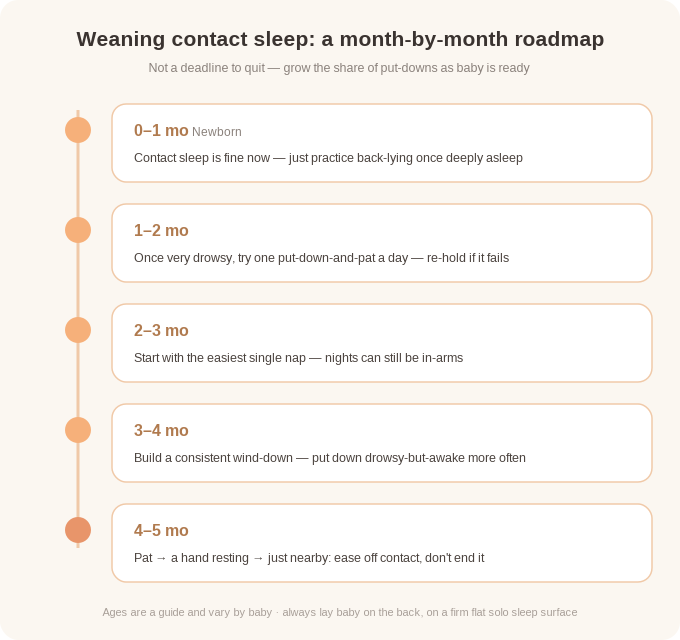
At a glance, here's the flow. The table below is only a guide to set your direction, and you can follow your baby's signs of readiness rather than their exact age.
| Age | What to try gently at this stage | What to keep doing |
|---|---|---|
| 0–1 month | Practice laying baby down flat on their back once deeply asleep | Falling asleep during holding or feeding, safe sleep |
| 1–2 months | When very drowsy, try laying down and patting once a day | Moving them only after they're fully asleep |
| 2–3 months | Lay down and settle for the one easiest nap of the day | It's fine to lean on arms a lot for night sleep |
| 3–4 months | Same bedtime routine every time, plus more laying down while awake | Laying baby down for naps |
| 4–5 months | Ease off contact: patting → a resting hand → just staying nearby | Back to arms when unwell, safe sleep |
Newborn stage (0–1 month): contact sleep is fine for now, just the safety habits
This is a stage where babies fall asleep mostly in your arms or during feeding. Rather than trying hard to cut down on contact naps now, it's enough to simply repeat the practice of laying your baby down flat on their back once they're deeply asleep. Don't rush if you don't succeed in laying them down. It's enough to spend just a tiny bit of time, little by little, letting them play on their back while awake during the day so they get used to the feel of the surface.
1–2 months: start trying to lay them down "while drowsy"
While continuing to move them only after they're fully asleep, add in laying them down and patting while they're very drowsy but still awake, starting from once a day. This practice lets your baby experience, little by little, not only "falling asleep while held" but also "falling asleep lying on a surface." If it fails, it's perfectly fine to pick them back up and settle them in your arms. At this stage, failing more often is normal.
2–3 months: start by laying them down for one nap
This is when the share of deep sleep begins to grow, so your success rate at laying them down gradually rises. Pick the one nap of the day they fall asleep most easily, and practice laying them down just for that one. The key is to start with a single nap rather than trying to change every sleep at once. For night sleep, it's still fine to lean on your arms a lot.
3–4 months: keep the falling-asleep setting consistent, and lay them down awake more often
Now is the time to build a bedtime routine. Repeating the same order every time, such as darkening the room, quietly singing a lullaby, and patting, helps your baby feel "it's time to sleep now" and settle more easily. Alongside this, gradually increase how often you lay them down while drowsy but awake. That said, around this time a sleep regression at about four months may mean you need to hold them a little more for a while. This is natural, so we'll cover it in a later section.
4–5 months: practice self-settling, ease off contact without cutting it off completely
This is a stage when development like rolling over changes their sleeping position and they become more active. Rather than eliminating arms-to-sleep all at once, reduce it in steps, like patting to sleep → just resting a hand lightly → staying beside them. When your baby is unwell, teething, or going through strong stranger anxiety, arms may increase again, and that's okay. Remembering that the path of easing off isn't always a straight line will set your mind at ease.
The one thing to keep in common at every stage is this: when you lay your baby down, always place them on their back on a firm, flat surface, not inclined and not on their stomach, and never left to sleep on a sofa, an adult bed, or an adult's body. As long as you keep this principle, you can match everything else to your baby's pace.
4. Small tricks that work at every stage
These are tips that help at any stage, regardless of age. On days when laying your baby down is especially hard, try them one at a time.

Move them at the deep-sleep moment
When their arms and legs go limp, their hands relax, and their breathing becomes even and deep, it's a sign they've entered deep sleep. Rather than laying them down right after they fall asleep, holding them another 10 to 20 minutes until you see this sign, then moving them, raises your success rate.
Reduce the temperature gap
Moving your baby from your warm arms to a cool surface makes it easy for them to wake at the temperature gap. Warming a handkerchief briefly in your arms and placing it under your baby's back first, or warming the surface slightly beforehand, reduces the gap. That said, when warming the bedding, be careful of overheating and burns, and always remove whatever you used to warm it before laying your baby down. Letting a baby sleep with a hot water bottle or electric blanket left underneath is dangerous.
The order of laying them down
Holding them, lower them slowly in the order of bottom → back → head, and pull the supporting hand out very slowly, last of all. If their arm shoots up mid-way from the Moro reflex, just rest a hand lightly on their chest, pat gently, and wait until they settle again.
Managing awake time
Surprisingly, being overtired actually keeps them from sleeping. If your baby has been awake longer than is right for their age, they can become overstimulated, making it harder to lay them down. Putting them to bed in line with the appropriate "wake window" for their age is the hidden key to laying them down successfully, and how to catch this timing is covered in how to time naps to wake windows.
5. The sleep regression around four months, going back to arms is okay
When a baby who used to lie down well suddenly starts wanting only your arms and waking often, it's disheartening to think, "Has all the practice gone to waste?" But this is often a sleep regression that commonly arrives around four months.
During this time, your baby's sleep structure shifts to resemble an adult's, the rhythm of cycling between light and deep sleep is reorganized, and they wake often during sleep and come looking for your arms again. Teething, stranger anxiety, or a growth spurt may overlap too. What matters is that this is a temporary change, not a step backward.
At times like these, rather than forcing the laying-down, hold them a little more for a while, but keep the bedtime routine and the principles of safe sleep just as they are. Once the regression passes, your baby usually comes back looking a stage more grown. You can continue the laying-down practice then, so there's no need to rush or blame yourself during this period.
6. When not to judge on your own
Most contact naps naturally decrease as your baby gets older. Still, when it comes to safety there's a line you must keep, and please look closely at the signs below rather than judging alone.
- Don't leave a sleeping baby on an adult bed or sofa, on an adult's body, or in an inclined bouncer or car seat. During sleep, laying them on their back on a firm, flat sleep surface used by the baby alone is the foundation for preventing suffocation and sudden infant death.
- If your baby can't sleep well even in your arms and wakes often with harsh or labored breathing, isn't gaining weight well, or keeps showing unusual, severe fussiness or lethargy, consult a pediatrician. These can be signs of a different nature than a simple contact-nap worry.
- Sleep training is something you choose to fit your baby's age and temperament and your family's situation. Methods that leave a baby to cry hard, alone, for a long time aren't recommended, and it's hard to declare any one method the right answer. If it feels like a burden or you're not confident, it's a good idea to consult a professional.
The ages, times, and counts written here are all for reference, and they vary a lot from baby to baby. If worrying signs keep repeating or things look very different from usual, talking with a professional is the safest choice rather than judging on your own.
Frequently asked questions
Q. If my baby only sleeps in my arms, will it become a habit I can never break?
No. Wanting to sleep well in your arms is natural in terms of development, and as your baby gets older, deep sleep increases and they develop the ability to sleep on their own, so it usually improves little by little. The fact that laying them down is hard now doesn't mean it will never work, so you don't have to strain to quit in a hurry.
Q. From what month should the "back sensor" phase end?
There's no set "end point." Since babies reach readiness at different speeds, it's more natural to gradually increase how often you lay them down when you see signs that they sleep well even when laid down, rather than ending it at a specific month. Usually you start by laying them down for one nap and gradually widen the range.
Q. My baby wakes right away when I lay them down after holding them to sleep. How do I move them?
The key is to move them after confirming the deep-sleep signs, when their limbs go limp and their breathing turns deep and even. Lower them slowly from bottom to back to head, and pull the supporting hand out last of all. If they startle from the Moro reflex, resting a hand on their chest to pat and settle them before lifting your hand away raises the success rate.
In short
- Wanting to sleep in your arms isn't a wrong habit, it's natural development. There's no need to quit in a hurry; you can gradually increase how often you lay your baby down in step with their age.
- In the newborn stage, just practice laying down safely; at 2–3 months, start with one nap; at 4–5 months, start with patting to sleep, easing off in stages. Coming back to your arms around four months is a temporary sleep regression, so you can rest assured.
- At every stage, keep this one thing without fail: once your baby is asleep, move them onto their back on a flat surface for safe sleep. If they aren't gaining weight, their breathing is harsh, or severe fussiness or lethargy persists, consult a pediatrician.
If you record the time your baby fell asleep, the length of naps and night sleep, and whether laying them down worked in Babyfolio for just a few days, you'll see the flow of contact naps gradually decreasing as your baby gets older, which eases the sense of urgency a great deal. Even if laying your baby down was hard today, your little one is still growing just fine, at their own pace.